My vote for the greatest movie ever made: Women In Love (1970), directed by Ken Russell, adapted from the 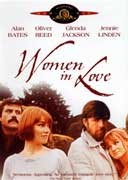 novel by Larry Kramer, starring Alan Bates, Glenda Jackson, Oliver Reed, Jennie Linden and Eleanor Bron.
I saw this in a theater during my 3rd year in college. My English teacher took me. We had a pizza afterward and talked it to death. It is a glorious movie: full of wit, color, angst, passion, death and love. Russell exercised just enough restraint to keep the film from becoming silly and yet managed to let a healthy taste of strangeness ooze in. For utterly silly Ken Russell, see ‘The Music Lovers’ with Richard Chamberlain as a gay Tchaikovsky . . . if you can find it.
In ‘Women in Love,’ Glenda Jackson is superb (a word she uses in the film)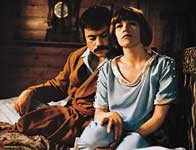 and, in fact, won the Oscar for best actress that year for her portrayal of Gudrun. Her nighttime scene in the seedy section of town is most memorable. ‘How are your thighs?’ she asks the gritty miner who is propositioning her as she walks through the open market. ‘Me thighs?!’ he comes back. ‘Yes; because I want to drown in flesh; hot, physical flesh.’ She says this just before she knees him in the crotch, pushes him away and proclaims, ‘You’re hideous and disgusting like all the rest!’
Jennie Linden plays her sister, and although overlooked by most reviewers, turns in an outstanding performance. Her angry scenes are truly inspired: ‘You take your rings back and go buy yourself a female elsewhere!’ she screams. And Eleanor Bron, who you probably remember from the Beatle’s movie, ‘Help!’ is utterly captivating as the slimy and neurotic Hermione. ‘How can you think me not sensual?’ she asks Birkin, 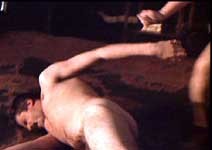 her head tilted at such an angle as to make her neck appear broken by his assault on her pornographic sexuality.
Then there are the men. Ah, yes; Alan Bates as Rupert and Oliver Reed as Gerald. Their nude wrestling/love scene is, of course, remarkable for many reasons, not the least of which is that they were both willing to do it. Here in 1970 are two male stars, completely naked, showing everything, rolling around on the floor in sweaty abandon. It is a beautifully staged and photographed scene. But there is so much more. Reed plays Gerald so tightly his character nearly screams in anguish from his pores. His last words in the film, after Gudrun has moved out of their room in the chalet, are to Loerke, the rodent like German artist with whom she now spends her time. He takes Loerke’s right hand in his left, as if to dance, and decks him with one frighteningly hard right to the face. 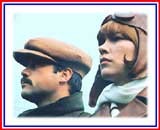 ‘I didn’t want it anyway,’ he forces through his clenched teeth. Then he walks off in his snow shoes, into the mountains, where he finally sits down in the snow, goes to sleep and freezes to death.
Finally, Alan Bates gives the performance of a lifetime. You cannot help but ache for him as he presents the complex and sexually ambiguous Rupert Birkin. His love for Gerald is so apparent yet so restrained. And the last four words of the movie, his words, are a line drawn in the sand between him and his new wife, Ursula. She has taken yet another opportunity to point out that Rupert’s desire for the perfect love of another man — Gerald — in addition to his love for her is ‘impossible; a perversion.’ There is a pause, then Rupert, staring hard into her eyes, says, ‘I don’t believe that.’ And a deep and foreboding chord ends the movie.
Finally, I can’t complete my song of praise without talking about Larry Kramer. His adaptation is pure genius. Not only does 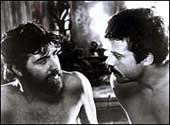 he capture the action of Lawrence’s complex, talky and at times convoluted novel, but he turns it into an edge of the seat adventure ride. I’ve seen this movie a dozen or more times . . . enough that I half recite the script along with the actors . . . and I still can’t turn away. I don’t believe there’s ever been a better adaptation of a novel. One of my favorite scenes is the backyard picnic at Hermione’s country ‘cottage.’ Rupert launches into his ‘proper way to eat a fig’ speech, which does not appear in the book. Kramer lifted that from another piece of Lawrence’s writing . . . and with its addition, huge pieces of Rupert’s, Hermione’s, Gerald’s, Ursula’s and Gudrun’s personas are revealed. Here is Anthony Bourdain on Women In Love.
Listen: if you’ve invested the time and brain power to read this entire post, you owe it to yourself to go out and at least rent the movie. If you can find it, go for the DVD with commentaries by Russell and Kramer. Watch the movie once, then again and again with the commentaries. I think you’ll have a new favorite movie.